


ABUNDANT
Increasing housing supply by navigating legal and financial development roadblocks
UNSUBSIDIZED
Focusing on long-term policy reform and smart design, rather than limited federal subsidies
ATTAINABLE
Designing projects that are feasible to build and feasible to afford for more families
RESPONSIBLE
maximizing housing opportunities while providing access to jobs, addressing community character, and protecting environmental resources
HOUSING CHOICE
( is )
Housing Choice describes Kronberg Urbanists + Architects’ process of designing abundant, attainable, and responsible housing and neighborhoods.
Over the years, we’ve crafted a housing inventory ranging from 250 SF studios to 12-unit missing middle plexes, with an eye towards promoting gentle density in communities constrained by restrictive zoning codes.
These units form the building blocks of better neighborhoods, and underpin our efforts to engage community leaders, developers, and other design professionals in addressing the United States’ housing crisis.
HOUSING CHOICE
is Kronberg Urbanists + Architects’ process of designing
abundant, attainable, and responsible housing and neighborhoods.
is Kronberg Urbanists + Architects’ process of designing abundant, attainable, and responsible housing and neighborhoods.
HOUSING CHOICE
is Kronberg Urbanists + Architects’ process of designing
abundant, attainable, and responsible housing and neighborhoods.
Over the years, we’ve crafted a housing inventory ranging from 250 SF studios to 12-unit missing middle plexes, with an eye towards promoting gentle density in communities constrained by restrictive zoning codes.
These units form the building blocks of better neighborhoods, and underpin our efforts to engage community leaders, developers, and other design professionals in addressing the United States’ housing crisis.
is Kronberg Urbanists + Architects’ process of designing
abundant, attainable, and responsible housing and neighborhoods.
Over the years, we’ve crafted a housing inventory ranging from 250 SF studios to 12-unit missing middle plexes, with an eye towards promoting gentle density in communities constrained by restrictive zoning codes.
These units form the building blocks of better neighborhoods, and underpin our efforts to engage community leaders, developers, and other design professionals in addressing the United States’ housing crisis.
55%
THE CHALLENGES
HOUSING MISMATCH
The United States is suffering from a housing mismatch, attributable to both restrictive zoning codes and transformative demographic shifts. Many areas have an oversupply of large, single-family houses and an insufficient supply of other housing forms, such as smaller single family homes or compact walk-up apartment buildings that fit into existing residential fabric.
hOUSING STOCK


(SELECT A YEAR)


HOUSEHOLD TYPES
- sOURCE
1960
2023
55%
hOUSING STOCK
HOUSEHOLD TYPES
THE CHALLENGES
HOUSING MISMATCH
The United States is suffering from a housing mismatch, attributable to both restrictive zoning codes and transformative demographic shifts. Many areas have an oversupply of large, single-family houses and an insufficient supply of other housing forms, such as smaller single family homes or compact walk-up apartment buildings that fit into existing residential fabric.
18%
7%
16%
29%
29%
1960
2023
LIVING SPACE PER PERSON
1058 SQ.FT.
2024
1950
292 SQ.FT.
2024
1058 SQ.FT.
1950
292 SQ.FT.
A DECLINE OF HOMES UNDER 1,400 SF
Despite the demand for smaller homes to accommodate smaller families, fewer than 10% of single-family homes built in the U.S. today are smaller than 1,400 square feet, the maximum size considered a ‘starter home’.
The average single-family home today provides over 1,000 square feet of living space per person: 3.5x the amount provided in the mid-twentieth century. This increase in the size of single-family homes directly correlates to an increase in housing costs.
LIVING SPACE PER PERSON
- SOURCE
THE INCOME LADDER
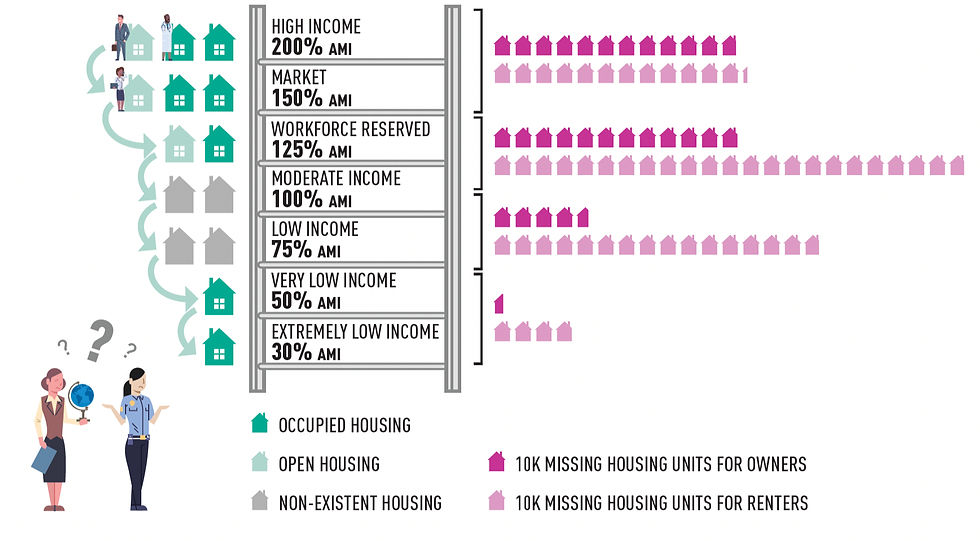
Insufficient housing stock across price ranges means increased competition for anyone looking for housing. Buyers at the highest income levels are forced to buy down the housing ladder: purchasing less expensive homes when they might spend more, given the opportunity. This leaves fewer options for both buyers and renters at lower income levels and puts pressure on each successive neighborhood. The largest deficit in housing exists for those earning between 75-125% Area Median Income (AMI). When the highly limited quantity of housing attainable to this income bracket is bought or rented by those in higher income brackets, few, if any housing options are left.
HOUSING DEFICIT
AVAILABLE HOUSING BUY DOWN
OCCUPIED HOUSING UNITS
AVAILABLE HOUSING UNITS
MISSING HOUSING UNITS
10k MISSING HOUSING UNITS FOR OWNERS
10k MISSING HOUSING UNITS FOR RENTERS
tHE AVAILABLE HOUSING BUY DOWN
THE HOUSING DEFICIT
HOUSING DEFICIT
AVAILABLE HOUSING BUY DOWN
THE HOUSING DEFICIT
120% + AMI
HIGH INCOME
80-120% AMI
MID INCOME
50-80% AMI
MOD INCOME
<50% AMI
LOW INCOME
- SOURCE
THE INCOME LADDER
Insufficient housing stock across price ranges means increased competition for anyone looking for housing. Buyers at the highest income levels are forced to buy down the housing ladder: purchasing less expensive homes when they might spend more, given the opportunity. This leaves fewer options for both buyers and renters at lower income levels and puts pressure on each successive neighborhood. The largest deficit in housing exists for those earning between 75-125% Annual Median Income (AMI). When the highly limited quantity of housing attainable to this income bracket is bought or rented by those in higher income brackets, few, if any housing options are left.
OCCUPIED HOUSING UNITS
AVAILABLE HOUSING UNITS
MISSING HOUSING UNITS
10k MISSING HOUSING UNITS FOR OWNERS
10k MISSING HOUSING UNITS FOR RENTERS
tHE AVAILABLE HOUSING BUY DOWN
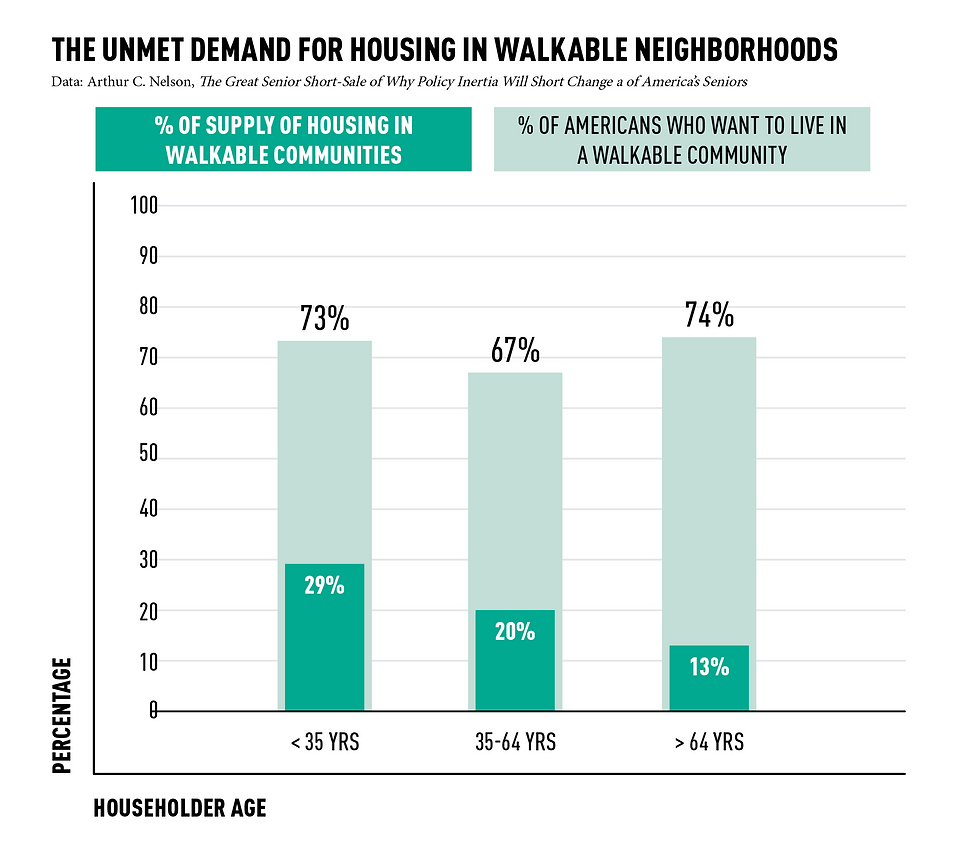
UNMET DEMAND
A majority of individuals—across all age groups—want to live in walkable communities. The problem is, less than 10% of housing is located in walkable neighborhoods. This increases demand, and therefore housing costs, in limited walkable areas.
We like to say: it’s not a shortage of walkable neighborhoods, but a shortage of housing in walkable neighborhoods.
100%
% OF AMERICANS WHO WANT TO LIVE IN
WALKABLE COMMUNITIES
% OF SUPPLY OF HOUSING IN
WALKABLE COMMUNITIES
73%
29%
< 35 YRS
67%
20%
35 - 64 YRS
74%
13%
35 - 64 YRS
tHE UNMET DEMAND FOR HOUSING IN WALKABLE NEIGHBORHOODS
0%
We need to build more housing that matches our current needs:
SMALL, ATTAINABLE, AND IN WALKABLE NEIGHBORHOODS
We need to build more housing that matches our current needs:
SMALL, ATTAINABLE, AND IN WALKABLE NEIGHBORHOODS

THE VARIABLES
A seemingly minor technical detail—which building code applies to your project—can determine whether attainable housing pencils out or dies on the drawing board. Two building codes govern how we construct housing in the United States: the International Residential Code (IRC) and International Building Code (IBC). The IRC and IBC are comprehensive codes designed for specific building types, differing in requirements and scope. KUA offers both IRC (cottages) and IBC (plexes) housing solutions. Understanding the distinctions between the IRC and IBC is crucial for designing a successful, responsible, and attainable project.
IRC is generally the simpler of the two building codes. It is designed specifically for: single-family homes, two-family residences, and townhomes.

IRC (International Residential Code) covers single-family homes, dublexes, townhomes, and accessory structures up to three stories.
Built by single-family contractors
Simpler permitting for building & site
traditional single family residential parking, tax & Trash Pick up
Smoke alarms, simple fire-rated seperations
simpler insulation & hvac requirements
residential stormwater (if any) & lot coverage requirements
single-faMILY UTILITY CONNECTIONS
IBC
IBC is the comprehensive code that applies to everything not covered by IRC: 3+ multifamily buildings, commercial buildings, mixed-use developments, and institutional buildings. While more complicated than IRC projects, IBC buildings are valuable tools in the right contexts.

IBC (International Building Code) governs multifamily (3+ units), commercial, and mixed-use buildings.
TYPICALLY REQUIRES A COMMERCIAL CONTRACTOR & SUBCONTRACTORS
MORE ENGINEERING & PERMITTING REQUIREMENTS
"COMMERCIAL" PARKING REQUIREMENTS, TAX CLASSIFICATION, MUNICIPAL TRASH, ETC.
fIRE-RATED SEPARATIONS + NFPA 13/13R SPRINKLERS + COMMERCIAL ALARM SYSTEMS
"COMMERCIAL" AIRFLOW & BUILDING PERFORMANCE REQUIREMENTS
ON-SITE STORMWATER DETENTION, GRADING, & LOT COVERAGE REQUIREMENTS
MORE COMPLEX CONNECTION REQUIREMENTS, CAN REQUIRE BACKFLOW PREVENTERS, ONSITE TRANSFORMERS,
MORE COMPLEX CONNECTION REQUIREMENTS, CAN REQUIRE BACKFLOW PREVENTERS, ONSITE TRANSFORMERS,
May have accessibility requirements
IRC

HOME OWNERSHIP or ATTAINABLE RENTAL
A key factor in determining which parts of KUA’s housing choice inventory are correct for a project is determining the ownership goals of a project:
KUA’s small IRC cottages are an excellent choice for projects that prioritize homeownership. If allowed by local subdivision ordinances, these homes can be built and sold fee-simple.
While our cottages can also work as rental projects, our IBC missing middle options really shine when density and attainable rent are the priority. Our plexes include two- and three-story walkup buildings with anywhere from four to twelve units. Unlike large apartment buildings, these plexes echo historical neighborhood forms, providing gentle density while blending in with the existing building scale.
OUR APPROACH
HOUSING CHOICE CATALOG
Housing Choice influences every part of KUA’s practice: at the scale of an individual unit to the layout of a new master plan. We’ve put in years of hard work refining our inventory: from small-format cottages, to multi-home configurations, to 12-unit plexes.
OUR APPROACH
HOUSING CHOICE CATALOG
Housing Choice influences every part of KUA’s practice: at the scale of an individual unit to the layout of a new master plan. We’ve put in years of hard work refining our inventory: from small-format cottages, to multi-home configurations, to 12-unit plexes.
Cottages


packs


plexes


Cottages
packs
plexes
UNITS + VARIATIONS
Our housing choice units are modular, allowing for dozens of design variations. Porch locations can shift to address the street or frame a shared garden. Front elevations can adapt to reflect local character. Plans can expand, compress, or attach to form packs or stacks. Add-ons allow projects to respond to site constraints, zoning requirements, and market goals. The result is a flexible system of buildings that can be deployed in many contexts. It is a practical approach to creating more housing without reinventing the wheel each time.
UNITS + VARATIONS
Our collection of units makes up our design catalog. Our practical design approach allows certain units to vary. Porch locations can shift to address the street or frame a shared garden. Front elevations can adapt to reflect local character. Plans can expand, compress, or attach to form packs or stacks. Add-ons allow projects to respond to site constraints, zoning requirements, and market goals. The result is a flexible system of buildings that can be deployed in many contexts. It is a practical approach to creating more housing without reinventing the wheel each time.


CYPRESS
Gross SF
Porch SF
Stories
Front Porch Orientation
Design Options
Add Ons
1380
90
2
Bathrooms
Stories
Units
2.5
2
1


SITE PLANNING
Our cottages and plexes are not just individually efficient, they complement each other even at the site-planning scale. Generous porches frame community greenspaces and gentle density puts residents within walking distance of local amenities. Our simple, cute designs set the stage for building flourishing communities.
SITE PLANING
Our cottages and plexes are not only individually efficient, but they are also designed to complement each other on a large scale: great porches can frame community greenspaces and gentle density puts residents within walking distance to support local amenities. The designs are simple, cute, and set the stage for community building.
ATTAINABLE CONSTRUCTION
The modularity of our units mean we can provide construction drawings at an attainable price. We can modify sets to comply with local building codes and design preferences, whether it’s a larger porch, alternate exterior finish, or regional design variation. There are costs associated with these modifications, but with reasonable base design fees, the math works out favorably. It’s a win-win situation for everyone involved!

WORK WITH US
WORK WITH US
By adding more housing options, we are not just addressing a crisis; we are fostering communities where diversity flourishes and where every resident can thrive. Housing is a fundamental right, and it is our duty as architects and urban designers to champion solutions that dismantle barriers and promote access and opportunity. Read more about how—and why!—to work with us to tackle housing challenges in your community, here.
Reach out to us, and let’s explore how we can harness our combined passions and expertise to create housing solutions that truly make a difference. Together, we can reshape neighborhoods to be more attainable for all.
Let’s connect and make it happen!
ABUNDANT
( Lower costs by making more homes legal and buildable. )
UNSUBSIDIZED
( Workforce housing without federal subsidies, preserving essential public resources. )
ATTAINABLE
( Feasible to build and realistically affordable for residents. )
RESPONSIBLE
( Built near existing infrastructure to protect land and cut travel. )
HOUSING CHOICE
( is )
THE CHALLENGES
HOUSING MISMATCH
The United States is suffering from a housing mismatch, attributable to both restrictive zoning codes and transformative demographic shifts. Many areas have an oversupply of large, single-family houses and an insufficient supply of other housing forms, such as smaller single family homes or compact walk-up apartment buildings that fit into existing residential fabric.
LIVING SPACE PER PERSON
1058 SQ.FT.
2024
1950
292 SQ.FT.
2024
1058 SQ.FT.
1950
292 SQ.FT.
LIVING SPACE PER PERSON
- SOURCE
A DECLINE OF HOMES UNDER 1,400 SF
Despite the demand for smaller homes to accommodate smaller families, fewer than 10% of single-family homes built in the U.S. today are smaller than 1,400 square feet, the maximum size considered a ‘starter home’.
The average single-family home today provides over 1,000 square feet of living space per person: 3.5x the amount provided in the mid-twentieth century. This increase in the size of single-family homes directly correlates to an increase in housing costs.


THE CHALLENGES
HOUSING MISMATCH
The United States is suffering from a housing mismatch, attributable to both restrictive zoning codes and transformative demographic shifts. Many areas have an oversupply of large, single-family houses and an insufficient supply of other housing forms, such as smaller single family homes or compact walk-up apartment buildings that fit into existing residential fabric.
LIVING SPACE PER PERSON
1058 SQ.FT.
2024
1950
292 SQ.FT.
2024
1058 SQ.FT.
1950
292 SQ.FT.
- SOURCE
A DECLINE OF HOMES UNDER 1,400 SF
Despite the demand for smaller homes to accommodate smaller families, fewer than 10% of single-family homes built in the U.S. today are smaller than 1,400 square feet, the maximum size considered a ‘starter home’.
The average single-family home today provides over 1,000 square feet of living space per person: 3.5x the amount provided in the mid-twentieth century. This increase in the size of single-family homes directly correlates to an increase in housing costs.


18%
7%
16%
29%
29%

44%
4%
8%
30%
13%
63%
37%
LIVING SPACE PER PERSON
LIVING SPACE PER PERSON
1058 SQ.FT.
2024
1950
292 SQ.FT.
A DECLINE OF HOMES UNDER 1,400 SF
2024
1058 SQ.FT.
1950
Despite the demand for smaller homes to accommodate smaller families, fewer than 10% of single-family homes built in the U.S. today are smaller than 1,400 square feet, the maximum size considered a ‘starter home’.
The average single-family home today provides over 1,000 square feet of living space per person: 3.5x the amount provided in the mid-twentieth century. This increase in the size of single-family homes directly correlates to an increase in housing costs.
Despite the demand for smaller homes to accommodate smaller families, fewer than 10% of single-family homes built in the U.S. today are smaller than 1,400 square feet, the maximum size considered a ‘starter home’.
The average single-family home today provides over 1,000 square feet of living space per person: 3.5x the amount provided in the mid-twentieth century. This increase in the size of single-family homes directly correlates to an increase in housing costs.
LIVING SPACE PER PERSON
- SOURCE
THE CHALLENGES
HOUSING MISMATCH
The United States is suffering from a housing mismatch. We have an oversupply of large single family homes, and a deficit of small format housing choices, causing prices to soar. While some of this can be attributed to zoning codes constraining supply, much can also be said for transformative demographic shifts.
LIVING SPACE PER PERSON
1058 SQ.FT.
2024
1950
292 SQ.FT.
THE INCOME LADDER
Insufficient housing stock across price ranges means increased competition for anyone looking for housing. Buyers at the highest income levels are forced to buy down the housing ladder: purchasing less expensive homes when they might spend more, given the opportunity. This leaves fewer options for both buyers and renters at lower income levels and puts pressure on each successive neighborhood. The largest deficit in housing exists for those earning between 75-125% Annual Median Income (AMI). When the highly limited quantity of housing attainable to this income bracket is bought or rented by those in higher income brackets, few, if any housing options are left.

THE INCOME LADDER
When there aren’t enough homes, everybody competes for what’s available. Those at the highest income levels are forced to buy down the housing ladder into the next most desirable neighborhood. This puts pressure on each successive neighborhood. The largest deficit exists in housing for those between 75-125% Annual Median Income (AMI). The highly limited housing in this band is often bought or rented by those in higher income brackets, leaving those falling into that demographic with few if any housing options.
HOUSING LADDER
BUY-DOWN
INCOME LADDER
ESTIMATED HOUSING DEFICIT
UNMET DEMAND
A majority of individuals—across all age groups—want to live in walkable communities. The problem is, less than 10% of housing stock is located in walkable neighborhoods. This creates increased demand for a small amount of neighborhoods, which further drives up home prices in these desirable areas.
We like to say: it’s not a shortage of walkable neighborhoods, but a shortage of housing in walkable neighborhoods.
100%
tHE UNMET DEMAND FOR HOUSING IN WALKABLE NEIGHBORHOODS
0%
% OF SUPPLY OF HOUSING IN
WALKABLE COMMUNITIES
% OF AMERICANS WHO WANT TO LIVE IN
WALKABLE COMMUNITIES
67%
20%
35 - 64 YRS
74%
13%
35 - 64 YRS
73%
29%
< 35 YRS
UNMET DEMAND
A majority of individuals—across all age groups—want to live in walkable communities. The problem is, less than 10% of housing stock is located in walkable neighborhoods. This creates increased demand for a small amount of neighborhoods, which further drives up home prices in these desirable areas.
We like to say: it’s not a shortage of walkable neighborhoods, but a shortage of housing in walkable neighborhoods.

SMALL, ATTAINABLE, AND IN WALKABLE NEIGHBORHOODS
IRC
IRC is generally the simpler of the two building codes. It is designed specifically for: single-family homes, two-family residences, and townhomes.
IRC (International Residential Code) covers single-family homes, dublexes, townhomes, and accessory structures up to three stories.
Built by single-family contractors
Simpler permitting for building & site
traditional single family residential parking, tax & Trash Pick up
Smoke alarms, simple fire-rated seperations
simpler insulation & hvac requirements
residential stormwater (if any) & lot coverage requirements
single-faMILY UTILITY CONNECTIONS
IBC (International Building Code) govers multifamily (3+ units), commercial, and mixed-use buildings.
TYPICALLY REQUIRES A COMMERCIAL CONTRACTOR & SUBCONTRACTORS
MORE ENGINEERING & PERMITTING REQUIREMENTS
"COMMERCIAL" PARKING REQUIREMENTS, TAX CLASSIFICATION, MUNICIPAL TRASH, ETC.
fIRE-RATED SEPARATIONS + NFPA 13/13R SPRINKLERS + COMMERCIAL ALARM SYSTEMS
"COMMERCIAL" AIRFLOW & BUILDING PERFORMANCE REQUIREMENTS
ON-SITE STORMWATER DETENTION, GRADING, & LOT COVERAGE REQUIREMENTS
MORE COMPLEX CONNECTION REQUIREMENTS, CAN REQUIRE BACKFLOW PREVENTERS, ONSITE TRANSFORMERS,
MORE COMPLEX CONNECTION REQUIREMENTS, CAN REQUIRE BACKFLOW PREVENTERS, ONSITE TRANSFORMERS,
FHA, ADA, UFAS, ANSI = REQUIREMENTS UNFAMILIAR TO RESIDENTIAL CONTRACTORS
IBC
IBC is the comprehensive code that applies to everything not covered by IRC: 3+ multifamily buildings, commercial buildings, mixed-use developments, and institutional buildings. While more complicated than IRC projects, IBC buildings are valuable tools in the right contexts.
HOME OWNERSHIP or ATTAINABLE RENTAL
First, we determine the ownership goals for your project. Are we promoting homeownership, increasing rental attainability, or both? If homeownership is the primary goal, we often focus on small IRC cottages that can be built and sold fee-simple, assuming local subdivision ordinances allow it. For rental projects, we can still use these cottages, but we also draw from a wide range of “missing middle” options. These include two- and three-story walkup buildings, or “plexes,” such as fourplexes, sixplexes, and twelveplexes. Plexes usually fall under the IBC, which adds complexity and cost, sometimes make up for it in walkable locations.
Cottages


packs


plexes


single unit cottages
Multi unit townhomes
multi unit plexes
Front Porch Orientation
Design Options
Add Ons
CYPRESS
Gross SF
Porch SF
Stories
1380
90
2
Bathrooms
Stories
Units
2.5
2
1


SITE PLANS
ATTAINABLE CONSTRUCTION
The modularity of our units mean we can provide construction drawings at an attainable price. We can modify sets to comply with local building codes and design preferences, whether it’s a larger porch, alternate exterior finish, or regional design variation. There are costs associated with these modifications, but with reasonable base design fees, the math works out favorably. It’s a win-win situation for everyone involved!

WORK WITH US
WORK WITH US
By adding more housing options, we are not just addressing a crisis; we are fostering communities where diversity flourishes and where every resident can thrive. Housing is a fundamental right, and it is our duty as architects and urban designers to champion solutions that dismantle barriers and promote access and opportunity. Read more about how—and why!—to work with us to tackle housing challenges in your community, here.
Reach out to us, and let’s explore how we can harness our combined passions and expertise to create housing solutions that truly make a difference. Together, we can reshape neighborhoods to be more attainable for all.
Let’s connect and make it happen!